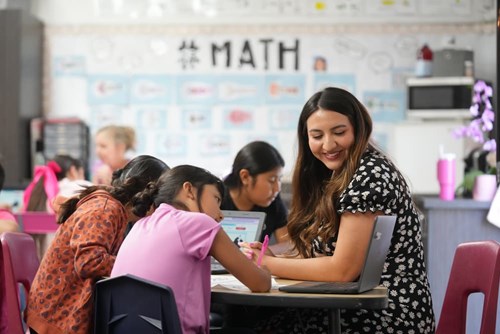
Teachers today seek strategies that do more than transmit content. They want methods for engaging students in learning that foster collaboration and sustained interest. Professional development courses can equip teachers with pedagogical tools to do just that.
Engagement is foundational to success when leading modern classrooms. The term “student engagement” refers to the behavioral, emotional and cognitive investment learners bring to their work. Engagement in this context includes attention, curiosity, perseverance and willingness to make meaning from what they learn.
When students are genuinely engaged, they learn more deeply, retain information more effectively and are more likely to persist in the face of challenges.
Why Engaging Students in Learning Matters
A meta-analysis of over 90,000 learners showed that teacher-student relationships and positive teacher behaviors were among the strongest external predictors of engagement. Another factor is connective instruction, which involves helping students see how material relates to their lives. That proves more powerful than merely “lively teaching” or challenging tasks in isolation.
Schools, however, often measure attendance or test scores rather than engagement itself. As Forbes notes, attendance may reflect presence, but it doesn’t capture whether a student is mentally “in the game.” Feedback, discourse, self-reflection and sustained inquiry are often better indicators of authentic engagement.
Strategies Learned in a Course on Student Engagement
A professional development course for educators typically offers teachers a toolkit of evidence-based strategies to better engage students. Below are a few key approaches.
Cooperative Learning Structures
Cooperative learning places students in small teams with roles and interdependence, so they must rely on one another to complete tasks. Properly structured, it supports peer explanations, shared ownership of learning and accountability. Teachers learn how to design tasks so that no one can “opt out.” When students explain ideas to one another, they internalize and articulate their thinking. That’s a powerful route to engagement.
Project-Based Learning (PBL) With Technology
In project-based learning, students tackle a real-world or meaningful question over time, creating concrete artifacts that demonstrate understanding. In a technology-enabled PBL course, teachers learn to:
- Design rigorous but open-ended driving questions
- Scaffold checkpoints and feedback loops
- Use digital tools (e.g., collaboration platforms, multimedia and simulations)
- Build authentic audiences (e.g., publishable products and public presentations)
- Assess both process and product
Through PBL, students become designers, researchers, problem solvers and creators. This gives them control and motivation, both fundamental in engaging students in learning.
Connective and Relational Instruction
Courses emphasize that engagement thrives in classrooms where relationships matter. Teachers learn to weave connective instruction into their practice by:
- Linking content to students’ lives, culture and interests
- Validating student voices and experiences
- Encouraging self-expression and student agency
- Giving feedback that builds confidence and offers pathways to succeed
- Using humor, curiosity and genuine care
These relational strategies make lessons more resonant and meaningful, anchoring learning in students’ identity and goals.
Launches, Hooks and Warm-Ups
A course might also teach how to design the opening moments of class to grab attention and build curiosity. Informational “hooks,” “bait-and-switch” prompts or short provocations prime students for the work ahead.
However, even the best lesson can lose momentum. Teachers also learn strategies for sustaining engagement:
- Frequent check-ins and formative feedback
- Peer critique and reflection cycles
- Adaptive scaffolds to support struggle without frustration
- Differentiation to meet learners where they are
- Gradual release of responsibility
These help maintain investment and deepen learning over time.
Bringing It All Together
When teachers apply these strategies, the classroom changes: students are more active, take ownership and engage intellectually. Active engagement, rather than passive reception, improves encoding and leads to better outcomes.
Over time, the classroom becomes a place where curiosity and collaboration flourish. When students feel seen, believe their work matters and can act as co-creators of knowledge, learning becomes more of an invitation than a task.
Fresno Pacific University’s online professional development courses, Project-Based Learning Using Technology and Engaging All Students Through Cooperative Learning, help teachers build a toolkit of evidence-based strategies for engaging students. The courses also provide educators with vital professional development credit. They are two of the many educator courses and professional development certificates teachers can earn entirely online from Fresno Pacific University.